
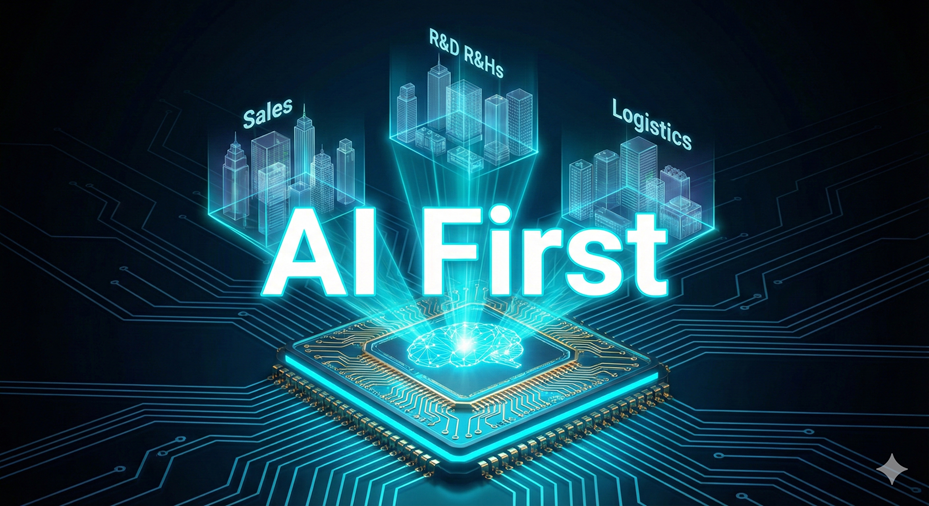
Introduction to IA First
In recent years, many companies have incorporated artificial intelligence into their daily operations. However, in most cases, AI has been used as a technology patchA one-off tool added to processes that were already inefficient. The result is often disappointing: low impact, low return on investment and an overall feeling of unnecessary complexity.
The approach AI First proposes a radical change. It's not about adding artificial intelligence to the company, but rather about redesigning the enterprise to operate with artificial intelligence at its core, The same way that in its day it went from “digitizing” to “operating digitally”.
This article explains why AI should become the company's operating system, What does it really mean to adopt a AI First model and why this approach is key to achieving real and sustainable results.
The most common mistake: using AI as an add-on
Many organizations have started using tools such as ChatGPT, virtual assistants or stand-alone automations. While these solutions can bring one-off improvements, they often present the same problems:
- They are not integrated into the central systems (ERP, CRM, databases).
- They depend on manual use by employees.
- They do not transform processes, they only partially accelerate them.
- They generate information silos and untraceable decisions.
This tool-first approach often results in the investment in artificial intelligence do not scale and is not consolidated as a real competitive advantage.
This is where the model AI First makes the difference.
What does it really mean to be a AI First company?
To be a company AI First means designing processes, systems and decisions based on artificial intelligence as a structural basis, not as a complement.
In a AI First model:
- AI executes repetitive and operational tasks.
- Business systems communicate with each other using AI.
- The information is analyzed in real time.
- People focus on strategic decision making.
- Automation is governed, audited and aligned with legal regulations.
AI ceases to be an external tool and becomes the business operating system, coordinating flows, data and actions on a continuous basis.
From “using AI” to “operating with AI”.”
The difference between the two approaches is structural:
| Traditional approach | Approach AI First |
|---|---|
| AI as a tool | AI as the operational core |
| Stand-alone automations | End-to-end processes |
| Manual use | Automatic execution |
| Low impact | Real scalability |
| Difficult to measure | Clear and measurable ROI |
Companies that adopt a AI First approach not only gain efficiencies, but adaptive capacity, This is critical in an ever-changing business environment.
AI as an enterprise operating system
An operating system coordinates resources, processes and decisions. In a AI First company, artificial intelligence fulfills exactly that function:
- Orchestrate workflows between departments.
- It connects data dispersed in different systems.
- Executes actions according to rules and context.
- Learn and improve with use.
This allows areas such as sales, administration, operations, legal, or management to work on a common same intelligent layer, reducing friction and operational errors.
Why the AI First approach is key to ROI
One of the main brakes to the adoption of artificial intelligence is uncertainty about the return on investment. The AI First approach addresses this problem by design:
- The processes with the greatest economic impact are identified first.
- Priority is given to automations with fast return on investment.
- Clear metrics are defined from the beginning.
- Technological over-implementation is avoided.
The result is that many organizations are beginning to see benefits in the first weeks, especially in time savings, error reduction and productivity improvement.
The role of consulting in a AI First model
Adopting a AI First approach is not about installing technology, it's about rethinking the company. For this reason, strategic consulting is a key element.
At ROBUST Data Solutions, This approach is articulated through the service IA Total Business - Strategic Consulting 2+1, which allows:
- Analyze in depth the current processes by department.
- Identify real opportunities where AI adds value.
- Design an action plan with a clear budget and defined priorities.
- Implement solutions with guaranteed return.
- To accompany the company in the continuous evolution of the AI First model.
This model avoids generic solutions and ensures that artificial intelligence is integrated in a consistent and sustainable manner.
AI First and legal compliance: an indispensable condition
Another common mistake is to implement AI without considering aspects such as data protection, governance or decision traceability from the outset.
A serious AI First approach integrates from the design:
- Compliance with GDPR and industry regulations.
- Access control and data usage.
- Audit of automated processes.
- Governance of models and decisions.
Without this framework, AI can become a risk rather than an advantage.
The bottom line: AI is not an option, the approach is.
The question is no longer whether your company should be using artificial intelligence, but rather how must do so.
Organizations that treat AI as a stopgap will continue to achieve limited results. Those that take a patchwork approach will continue to achieve limited results. AI First, where artificial intelligence acts as the operating system of the business, they will be better prepared to scale, adapt and compete.
If your company wants to move towards this model in a safe, structured and impactful way, the first step is not a tool, but rather a clear strategic vision.
👉 Discover how the AI First model can be applied to your company through a 2+1 strategic consultancy with ROBUST Data Solutions.