Diagnosis: where to start with AI in your company
Before implementing AI, Robust Data Solutions studies how your company works: processes, programs and tests with your real data. You keep the current snapshot and the roadmap, whether you go ahead or not. Then you decide, with all the information in front of you.
Why start with a diagnosis (and not a pilot)
No doctor prescribes without running tests
It’s hard, if not impossible, for a doctor to prescribe a treatment without first running tests: blood work, an X-ray, an ECG. That’s what allows them to give you the right prescription afterwards, tailored to your situation and with no surprises.
Our diagnosis is those tests. And the prescription is the proposal of what makes sense for your company, with its exact quote.
The diagnosis also measures where your team’s time goes. Up to 30% more team capacity, measured in diagnoses of real companies: if your annual payroll is €300,000, it’s like having up to €90,000 more capacity to get things done. Without hiring anyone.
Without a diagnosis, we don’t quote a development price. Anyone who gives you a price at the first meeting is guessing.
Diagnosis or pilot
Diagnosis vs. a generic pilot
There are two ways to get started with artificial intelligence: try out a tool in a pilot, or first study how your company works. Here’s how they compare:
| Diagnosis | Generic pilot |
|---|---|
| Starting point | |
| How your company really works, process by process. | An AI tool someone wants to try out. |
| What data it’s tested with | |
| Your real data, with the non-disclosure agreement and the data processing agreement signed. | Often sample data, or just a small part. |
| What gets measured | |
| Where the team’s time goes and what impact each improvement has. | Whether the tool works, not whether anything changes in the company. |
| What you keep if you don’t go ahead | |
| The current snapshot of your company and the roadmap to move forward. | Little more than the experience of the trial. |
| Control | |
| It’s designed with guardrails from the start: permissions per person, a log of every operation and a person who decides. | It’s often tested without permissions or logging, and that gets left for later. |
| Risk | |
| You decide with the exact budget in front of you, before investing in the implementation. | Investing in something that never gets used: according to a 2025 MIT study, 95% of generative AI pilots had no measurable impact on the bottom line. |
Source for the 95%: MIT NANDA, “The GenAI Divide: State of AI in Business 2025,” as reported by Fortune on August 18, 2025. It’s a study on generative AI, with a limited sample.
What we study: processes, programs and real data
We look at your whole company, the way it really works
Your programs, one by one
We review your whole digital ecosystem: which programs you use, whether they can be connected and how.
Interviews with key people
To understand processes as they are actually done, not as they are described. Very often, the way something is explained differs from the way it’s done.
The processes with the most potential
We pinpoint where your team’s time goes and where artificial intelligence adds the most.
Tests with your real data
We don’t work on assumptions: we test with your own data what can be done.
A prioritized proposal
The solutions, ranked by impact, with a detailed quote for the next phase.
The regulatory review
Data protection and the EU AI Act, from day one, not at the end.
What it doesn’t include: the diagnosis isn’t an IT hardware audit or a financial audit. We focus on your processes, your programs and your data.
What you keep, whether you go ahead or not
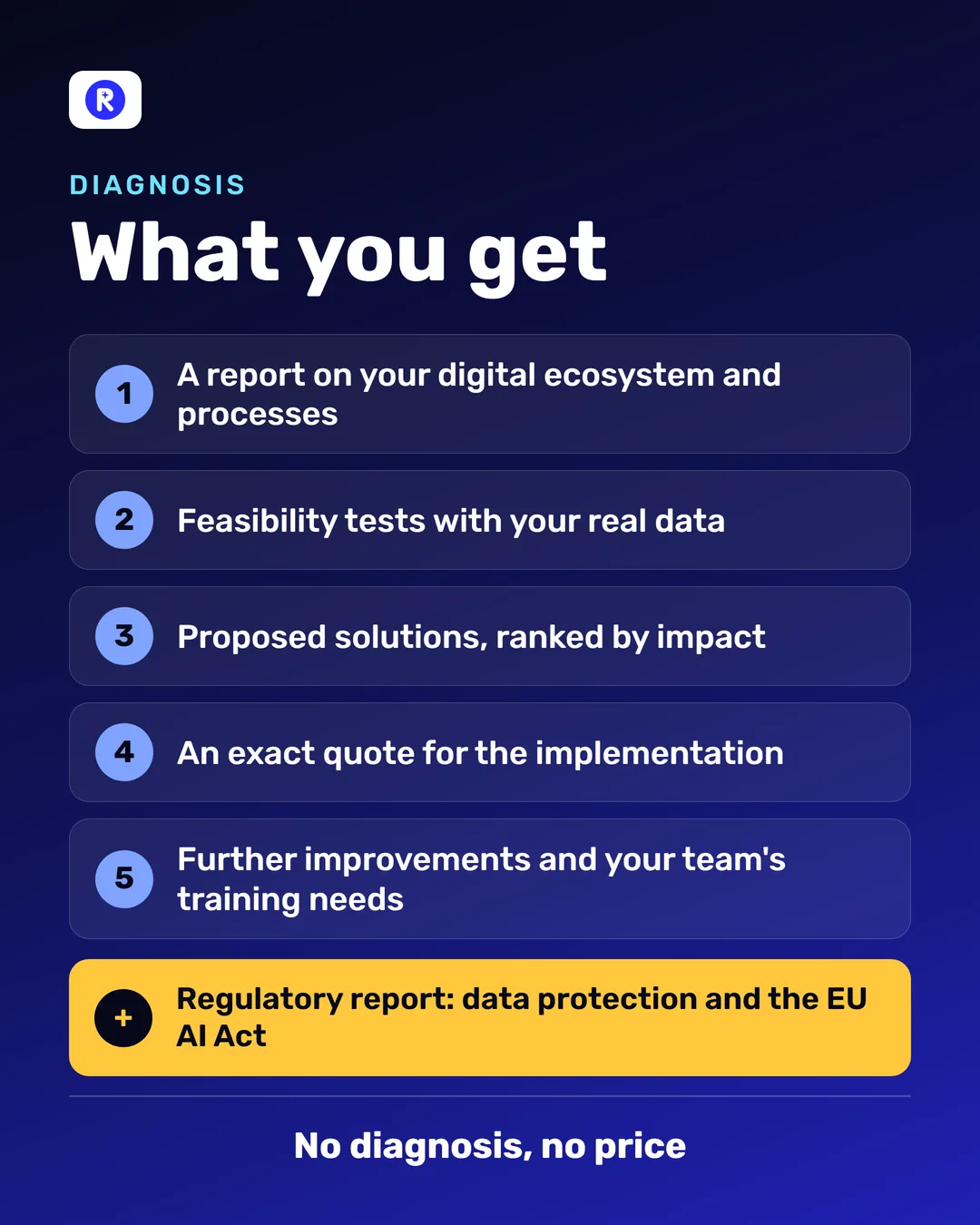
Five deliverables, plus the regulatory report
1. The diagnosis report
Your digital ecosystem, your processes, and everything we’ve found, in writing.
2. Feasibility tests
Done with your own data, so you can see what we propose working before you decide.
3. The solutions we propose
Ranked by impact, with the use cases and how they’ll be used day to day.
4. The exact quote for the implementation
Cost, schedule, resources and expected return. It’s the final quote: there won’t be another one later. No surprises.
5. Other improvements we spotted
Anything that comes up along the way, assessed separately, plus an assessment of the training your team needs.
+ The regulatory report
Data protection and the EU AI Act. In many AI projects it’s left until the end; here it comes first.
Every project goes through a regulatory compliance review (data protection and the EU AI Act) with our partner Forrellat Consultors, a Data Protection Officer registered with the Spanish Data Protection Agency (AEPD).
Next: the implementation
With the diagnosis in hand, you decide
If you go ahead, the implementation starts with the budget you already have, without starting over. If you decide not to, the diagnosis is still yours: you keep the snapshot of how your company works today and the roadmap to move forward. It has value on its own. Either way, you’ll know exactly what can be done in your company, what it costs and what it gives back. And with the peace of mind of deciding with data, not guesswork.
Frequently Asked Questions
How to get started with AI in your company
Where do I start implementing AI in my company?
With a diagnosis. Before implementing anything, Robust Data Solutions studies how your company really works—processes, programs and data—and tests what can be done with your real data. That gives you a proposal ranked by impact and the exact budget for the implementation, and you decide.
Why do so many AI pilots fail to deliver results?
Because many start with the tool and not the process: a generic AI gets tested with sample data and without measuring anything specific. According to a 2025 MIT study, 95% of generative AI pilots had no measurable impact on the bottom line. A diagnosis does the opposite: it starts from how your company works, tests with your real data and measures what you gain before you invest.
How long does the diagnosis take?
A few weeks, depending on the size of the company and the number of processes to be studied. We give you the schedule before we start.
What do we need from your team?
A few hours of the key people’s time for the interviews, and access to the programs and data needed for the tests. Before we touch a single piece of data, we sign a non-disclosure agreement and a data processing agreement.
Do I need to have my data organized first?
No. Organizing it is part of the job. If the diagnosis finds data scattered across Excel files or folders, or a very old program—say, a database custom-built years ago—it’s included in the proposal: first we bring it up to date with a data rescue and move the information to a modern program, custom-built if needed, that can then be connected securely. Then we connect everything to the AI.
What do you get at the end?
Five deliverables, plus the regulatory report: the diagnosis report, the feasibility tests with your data, the proposed solutions ranked by impact, the exact quote for the implementation and other improvements we spotted, as well as the report on data protection and the EU AI Act.
What do I keep if I decide not to go ahead?
The diagnosis is still yours: you keep the snapshot of how your company works today and the roadmap to move forward. It has value on its own. And if you go ahead, the implementation starts with the budget you already have, without starting over.
How much does the diagnosis cost?
It depends on your company: its size, the programs you use and the processes to be studied. We tell you before we start.
Why won’t you give me the implementation price right away?
Because it would be guesswork. Without knowing how your company works, its programs and its data, any figure is an assumption, and someone always ends up paying for the assumption. The diagnosis ends precisely with that price: exact, with no surprises.
Last reviewed: September 30, 2026
Shall we start with your company?
Tell us how you work and we’ll explain what the diagnosis would look like in your case.