
AI Agents with a Person in Charge: Robust Autopilots
Robust Autopilots are Robust Data Solutions’ artificial intelligence agents: autopilots that handle the repetitive work in your company on their own—incoming email, reminders, purchase invoices, follow-ups—always with a person in charge.
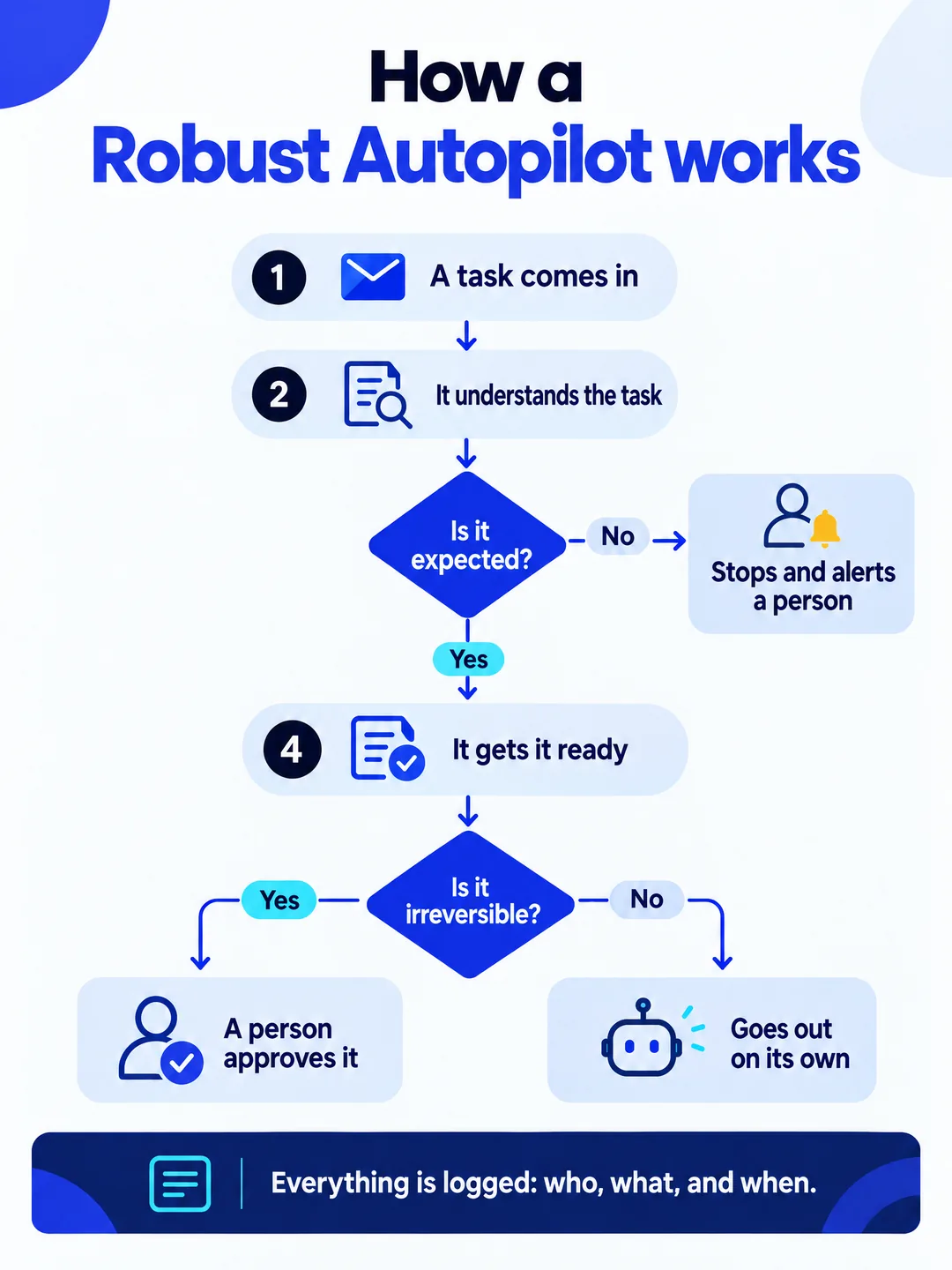
They only do what they’ve been programmed to do, with each person’s permissions. If something isn’t expected, they stop and alert someone. Anything irreversible waits for a person to approve it, and every step is logged. Your team gains capacity without hiring anyone.

What a Robust Autopilot is
An autopilot that asks for permission
Think of a task that comes up every day in your company: an email arrives, someone reads it, looks up the data in two programs, prepares the reply or the document and sends it. A Robust Autopilot does that whole route on its own, in the programs your team already uses, and leaves people what needs judgment and the final word on what matters.
Like an airplane’s autopilot: it flies the long, predictable stretch, and the captain stays in the cockpit, deciding when to engage it, keeping an eye on it and taking the controls as soon as anything goes out of the ordinary.
The difference from just any AI agent isn’t how smart it is, but what it’s allowed to do. Each Robust Autopilot has a specific job, just the permissions that job needs, and a clear rule about what it does on its own and what it asks you first. You decide where that line is:
| What’s included | Examples |
|---|---|
| Goes out on its own, with the rules and templates you’ve approved | |
| Routine, predictable work. It’s logged, and you can stop it whenever you want. | Appointment reminders, due-date notices, low-stock alerts, the weekly activity report. |
| Waits for your sign-off, every time | |
| Anything that goes out with new content, moves money or changes data. You approve all of it, part of it or none of it, and you can correct it first. | Replies to clients, accounting entries, collections, campaigns to win back clients. |
| Doesn’t do it | |
| Anything that hasn’t been programmed, and anything the person isn’t allowed to do. | If you can’t delete an invoice in your program, you can’t with AI either. If something isn’t expected, it stops and alerts someone. |
That line is drawn with you in the diagnosis, process by process, and it can be moved whenever you want. We also cover it in our news piece on autopilot with human oversight.
What tasks Robust Autopilots handle
In the office and in day-to-day operations
We don’t start from scratch at every company: we have autopilots already built and we tailor them to yours—your rules, your schedules, your templates and who to notify. And if you need something that doesn’t exist, we build it to measure.
Email in, email handled
They read what comes in, understand what’s being asked, sort it and prepare the reply or the document with the data from your programs. You review and send.
Purchase invoices and collections
They read supplier invoices and prepare their accounting entries; they match the bank statement against outstanding payments and suggest the ones that match. A person approves it before anything is booked.
Follow-ups and due dates
Quotes with no reply, overdue payments, deadlines running out: they alert the right person and, if you want, prepare the follow-up email for you to review.
Appointments and reminders on WhatsApp
They send the reminder, collect the client’s confirmation and, if the client can’t make it, flag the appointment for rescheduling and alert the team.
Documents on request
A request comes in by email: they understand it, generate the certificate or document with the data from your program and send it back, with whatever review you’ve decided on.
Alerts and reports
Stock below the minimum, paperwork that’s dragging on, the weekly activity summary: they inform the right person without changing any data.
How a Robust Autopilot works
Guardrails: control is part of the system
An agent that can send, charge or delete needs more than good intentions. That’s why the rules aren’t in an instruction that can be forgotten: they’re in how the system works.
Only what’s been programmed
Each autopilot has a specific job and just the tools that job needs. It doesn’t improvise or expand its work on its own.
It stops and alerts someone
If something isn’t expected—an email that doesn’t fit, a figure that doesn’t add up—it doesn’t guess: it stops and hands it to a person.
A log of every step
What it did, with what data, what it prepared and who approved it are all logged: who, what and when.
Permissions per person
Each autopilot works with the permissions it’s been given. What you can’t do in your program, the AI can’t do either.
A person approves anything irreversible
Sending something new to your clients, moving money or changing data waits for a person. In the approval inbox you see what it’s going to do and approve all of it, part of it or none of it.
It says what it is
What it writes to your clients is identified as an automated message, and they can always ask to speak to a person on your team.
Human in the Loop: AI proposes, a person decides
Our AI works with your data and never decides on its own: it proposes, and a person always makes the final decision. No sensitive action (money, contracts, customer data) is carried out without confirmation. Before anything changes, you see what it’s going to do and approve it.
And truly in charge, not just clicking “accept” without looking. An example of our own: in a mailing to our partners, the person rejected four of the six corrections the AI suggested before sending it.
AI agents that work alone, or with a person in charge
The difference isn’t how smart the AI is, but who governs it
The big vendors already sell agents that work alone, and they themselves surround them with approvals and review warnings. The latest example comes from Anthropic, the maker of Claude, the AI we recommend to our clients: on October 21, 2026, it launched Claude Duet, an agent that prepares your day every morning, checks your apps every few hours and asks your permission before sending, paying, signing or deleting. It’s the same idea behind Robust Autopilots: the AI no longer waits for you to ask, but what matters is approved by a person.
The difference is who it’s designed for. Duet is a personal assistant: it sees your email, your calendar and a handful of well-known apps, and for now it’s only available in the United States, on individual plans and with a waitlist. A business needs three more things: the AI has to get into the program where the real work happens, each person has to approve only what’s theirs to approve, and everything the whole team does has to be logged, the AI included.
When those three things are missing, the known failures follow a pattern, and it’s almost never that the AI “turns bad”:
- In April 2026, a coding agent found a key within its reach and deleted a software company’s production database, backups included, in nine seconds. The design failed: the key was within reach and the backups were in the same place.
- In February 2026, an AI executive at Meta told a personal AI agent to confirm before acting, and even so it deleted more than 200 emails from the inbox. An instruction in a chat can be forgotten; a permission in the system can’t.
- Gartner predicts that more than 40% of agentic AI projects will be canceled by the end of 2027 due to costs, unclear value or inadequate risk controls (forecast from June 2025).
- In its guidance on agentic AI of February 18, 2026, the Spanish Data Protection Agency (AEPD) calls for human checkpoints defined by design—especially before deleting data, sending communications or making payments—and for giving each agent only the permissions it needs. OWASP calls “excessive agency” the opposite: excess functionality, permissions or autonomy.
And although AI already prepares work very well, on its own it still isn’t reliable for the full job: we show it with a recent study on month-end closes. More cases and what the law says, in AI isn't dangerous. Ungoverned AI is.
| With Robust Autopilots | An ungoverned agent |
|---|---|
| What it can do | |
| The job it’s been programmed for, and nothing else. | Whatever you ask it in the chat, and sometimes whatever it reads into it. |
| Permissions | |
| Each person’s: what you can’t do in your program, the AI can’t do either. | Those of whoever set it up, often all of them. |
| The unexpected | |
| It stops and alerts a person. | It improvises a fix. |
| The irreversible | |
| It waits for a person’s approval. | It depends on an instruction that can be forgotten. |
| Records | |
| Every step: who, what and when. | There isn’t always a record. |
| The law | |
| A data protection and EU AI Act review before starting. | It’s left up to each user. |
Robust Autopilots already at work
Real cases, no names
A chain of hearing care centers
Eight autopilots on the clinical side and five on the accounting side. Appointment reminders and confirmations go out on their own every day on WhatsApp, and an appointment is never considered confirmed without a “yes” from the patient. If a hearing care professional can’t come in, an autopilot contacts each affected patient, offers dates from the real calendar and books the new appointment; anything that doesn’t get settled goes to the team. Campaigns to win back patients and accounting entries wait in the approval inbox, one by one.
A plant nutrition manufacturer present in more than 50 countries
It receives requests by email, understands them, and generates and returns the certificate of analysis with the data from its business software, with a person in charge. Its regulatory department went from hours to minutes.
A tax and accounting advisory firm
First, the diagnosis: we measured that 53.4% of the team’s productive time went into moving information from one place to another (our own diagnosis, 2026). Then came the income tax campaign, with the whole workflow automated by Robust Autopilots: no return is filed without a person’s review. AI for Tax and Accounting Advisory Firms
Ourselves
At Robust, the email inbox checks itself every five minutes, from 7 a.m. to 9 p.m.: whatever comes in gets sorted without anyone having to remember, and we set up the same for our clients. Every morning the day’s six priorities arrive on WhatsApp, an alert that can be switched off at any time. Before changing any data, the system shows what it’s going to do and asks for confirmation. We sell what we use.
We don’t name names: all our cases are anonymous.
With the programs you already use
We don't install a connector: we build it
Robust Autopilots work in the programs your team already uses: business software, accounting, email, WhatsApp, documents. We connect all your programs, today’s and tomorrow’s; if one is very old, we first bring it up to date. And every connection is custom development for your programs and your rules: that’s why an autopilot respects each person’s permissions and logs every step. We explain it in We don’t install connectors: we build them.
We add, we don’t replace: your program is still your program.
Where to start
First, the diagnosis: what to automate and what not to
We always start with a diagnosis: we look at how your team works, what repeats and where the time goes, with your real data. We automate what’s repetitive and predictable; the odd case goes to a person. An autopilot that tries to cover everything ends up failing in front of your clients. In the diagnosis we decide with you, process by process, what goes out on its own, what waits for your approval and what doesn’t get automated.
Up to 30% more capacity
Up to 30% more team capacity, for the same payroll cost, measured in diagnoses of real companies. Do the math for your own company: if your annual payroll is €300,000, it’s like having up to €90,000 more capacity to execute. Without hiring anyone.
The diagnosis is yours
If you decide not to go ahead, the diagnosis is yours anyway: you take away a snapshot of how your company works today and the roadmap to move forward. It has value in itself. What the diagnosis involves
The law comes first: GDPR and the EU AI Act
In artificial intelligence, the law comes first
In many AI projects, data protection and security are left until the end. Or not dealt with at all. Here they come first.
- Every project goes through a regulatory compliance review: data protection and the EU AI Act.
- Our data protection and regulatory compliance partner, Forrellat Consultors, is also our Data Protection Officer registered with the Spanish Data Protection Agency (AEPD), and reviews the data protection documentation of every project before it is signed.
- Before we touch a single piece of data: non-disclosure agreement and data processing agreement signed.
- Each person signs in with their own identity and only sees and does what their permissions allow. Every operation is logged: who, what and when.
- Data in Europe: processing on the platform runs on AI infrastructure and services located in the European Union. Using Claude or ChatGPT as the work interface is covered by the provider’s data processing agreement, with the European Commission’s standard contractual clauses.
It isn’t a certification: it’s a documented process, and we’ll show it to you.
Frequently Asked Questions
What people usually ask us about AI agents
What is an AI agent, and how is it different from a chatbot?
A chatbot answers; an agent does things: it reads an email, looks up data in your programs, prepares a document and sends it. That’s why it matters so much what permissions it has and who approves what it does. Ours are called Robust Autopilots: they handle repetitive work on their own, always with a person in charge.
Do Robust Autopilots make decisions on their own?
No. They handle routine work on their own, with the rules and templates you’ve approved, and everything else waits for a person. It’s our rule for everything: our AI works with your data and never decides on its own; it proposes, and a person always makes the final decision.
What happens if something isn’t expected?
It stops and alerts someone. A Robust Autopilot only does what it’s been programmed to do: if an email comes in that doesn’t fit or a figure doesn’t add up, it doesn’t guess or improvise; it hands it over to the person responsible. It’s what the Spanish Data Protection Agency (AEPD) calls an escalation path.
Which business tasks can be automated with AI agents?
The repetitive, predictable ones: processing incoming email, preparing purchase invoices for booking, matching payments against the bank, appointment reminders, follow-ups, documents on request, alerts and reports. Anything that needs judgment stays with your team. Where to start is decided in the diagnosis.
Is there a record of what the AI does?
Yes. Every step is logged: what the autopilot did, with what data, what it prepared and who approved it. If a client asks what’s been done with their data, you can show them.
Is it legal for an AI agent to write to my clients?
Yes, if it’s done right. Since August 2, 2026, anyone talking to an AI has to know it (Article 50 of the EU AI Act): what our autopilots write is identified as automated, and the client can always ask for a person. On top of that, every project goes through a regulatory compliance review with our partner Forrellat Consultors, a Data Protection Officer registered with the Spanish Data Protection Agency (AEPD). More details under compliance.
Do they work with the programs we already use?
Yes, whoever the vendor is: we connect all your programs, today’s and tomorrow’s, and we build each connection to measure. If one is very old—say, a custom database built years ago—we bring it up to date first: we rescue its data and move it to a modern program that can be connected securely. We assess it in the diagnosis.
Can I use the agents that already come with ChatGPT, Claude or my business software?
You can, and some are very good: Claude Duet, for example, prepares your day and asks your permission before sending anything. The difference is governance: each vendor’s agent sees its own apps and follows its own rules; Robust Autopilots work across all your programs, with each person’s permissions, a single log and your company’s rules. Before giving any agent access to client data, go through these seven questions.
Last reviewed: October 29, 2026
Tell us how your company works
Which tasks repeat every day and which ones take up most of your time. With that, we’ll show you which autopilots would fit your company and which one to start with.