
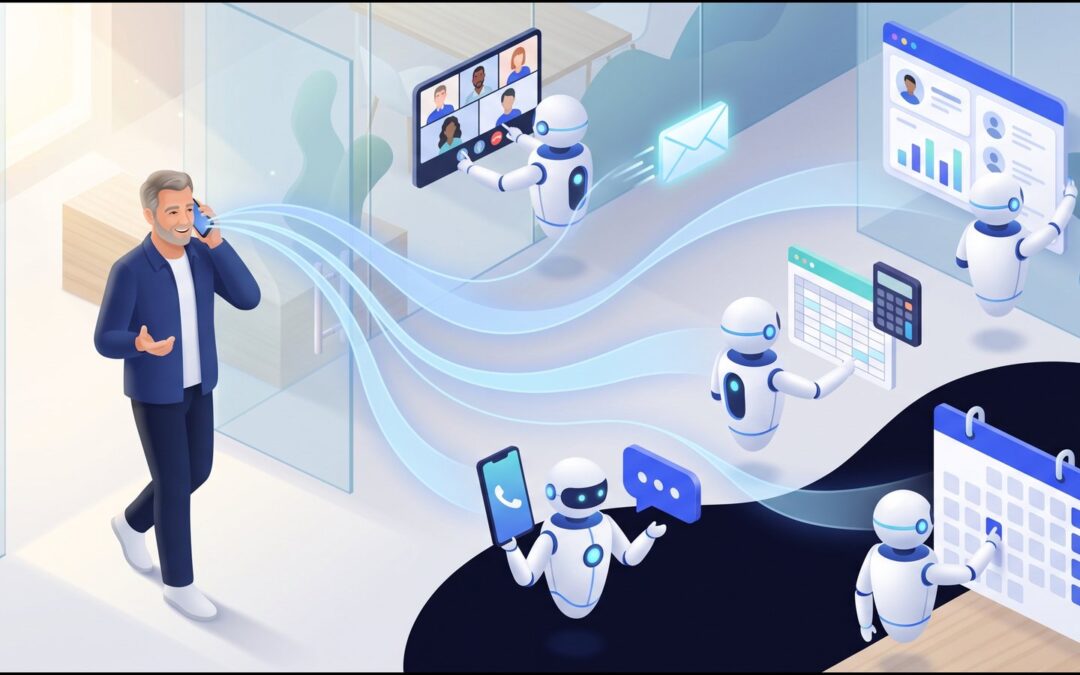
I’ve always said my drive to work reaches further than my eyesight. That’s why for years I dreamed of programming by voice, working by voice and, one day, running my whole company by voice.
That dream has come true. Today I run Robust this way, by talking. And what excites me most is that it’s no longer just mine.
For decades, working with business management software has meant the same thing: open it, find the right screen, fill in fields and repeat in the next program. The ERP in one place, email in another, customers in a third and documents in a folder nobody can find.
It doesn’t have to be that way anymore. Today there are ordinary local companies (a tax and accounting advisory firm, a manufacturer, a chain of hearing care centers, a law firm) that run a good part of their operations by talking. By text or by voice, from a single screen. And it isn’t a demo video: it’s their everyday work.
It isn’t dictation: it’s conversation
When we say “talking,” we don’t mean dictating a message. On your phone, with the Claude app, you have a real voice conversation with your company: you ask, it answers out loud, asks you to clarify when it isn’t sure, and does what you ask in your programs.
What sets it apart from a generic assistant is that this one knows your company and works with your data: your customers, your invoices, your calendar, your documents. And it does so with your permissions, not someone else’s.
An ordinary day, in a few sentences
The easiest way to see it is with examples. They’re all real sentences, just as people say them:
Management and collections
- “Which customers have owed us money for more than 60 days? Send them a reminder.” → the list appears, a reminder is prepared for each one and it goes out once you confirm.
- “What do I have tomorrow and what do I need to prepare?” → tomorrow’s calendar, with what’s still missing for each meeting.
Sales
- “Prepare the quote and send it to the person in charge.” → the quote is created in your usual program and sent.
- “Mark this quote as accepted.” → the system shows you what will change and does it once you confirm.
- “Show me the emails for this deal.” → they appear next to its record, without digging through your inbox.
Documents
- “Save this contract in the client’s folder,” with the PDF attached → it’s filed identical to the original, with the qualified electronic signature intact.
Customer and patient service
- “Reply to this WhatsApp with the order status.”
- “Remind tomorrow’s patients about their appointments.” → the WhatsApp reminders go out.
None of these sentences requires knowing where each piece of data is or which program it lives in. That’s exactly the point.
One sentence, seven tasks at once
Short sentences are fine, but where you really notice the difference is with long instructions, the ones that used to take up half your morning. For example, as you walk out of a meeting:
“Transcribe this morning’s meeting, send the executive summary to the team and the next steps to the client, prepare the quote and send it to them, update the CRM and tell Juan on WhatsApp we’re meeting on Friday to go over it.”
With that single instruction:
- the meeting is transcribed;
- an executive summary is prepared for your team;
- an email with the next steps is drafted for the client;
- the quote is prepared in your business management program;
- it is sent to the client;
- the client’s record is updated in the CRM;
- the WhatsApp message for Juan is prepared.
Seven tasks in five programs at once: the meeting app, email, the business management program, the CRM and WhatsApp. And before anything goes out, you see it and confirm it.
What happens under the hood
For a sentence like that to work, the artificial intelligence has to be connected to the programs your company already uses. We do it with smart connectors: one per program, and each one adds up. When email, accounting, customers and documents come together for the first time, the system sees what no single person can see at once.
And one important point: we add, we don’t replace. Your ERP is still your ERP and your email is still your email. There’s nothing to migrate and no new program to learn.
What it doesn’t do on its own
Running your company by talking doesn’t mean the AI decides for you. Our AI works with your data and never decides on its own: it proposes, and a person always makes the final decision. That’s what we call Human in the Loop.
- Nothing sensitive without confirmation. Money, contracts, customer data: before anything changes, you see what it’s going to do and approve it.
- Everyone, with their own permissions. Everyone signs in with their own identity and can only see and do what their permissions allow.
- Everything is logged: who, what and when.
And when something arrives without you asking
Talking is half of it. The other half is Robust Autopilots: autopilots that handle the repetitive work on their own, always with a person in charge. Two real examples (more in Cases):
- A plant nutrition manufacturer receives requests for certificates of analysis by email. The system understands the request, generates the certificate and sends it back, with a person in charge. Its regulatory department has gone from hours to minutes.
- At a tax and accounting advisory firm, income tax paperwork arrives by email and gets sorted, the filing is prepared, and a person reviews and approves it.
We use it ourselves first
Before offering it to anyone, we use it in-house. Robust runs on its own system: CRM, email, WhatsApp, calendar, documents and accounting, all connected to the same artificial intelligence.
- Since February we have made more than 2,600 changes in our CRM by talking to the AI, instead of filling in forms.
- Almost 600 documents about customers and projects can be searched by what they say, not just by their name.
- Reviewing and drafting a 40-page contract used to take us about 13 hours; today, one hour of review.
And how much do you gain?
It depends on each company, which is why we always start with a diagnosis: we measure how work really gets done and where the time goes before proposing anything. As a benchmark, the goal is for your team to gain up to 30% more capacity without hiring anyone. At an eleven-person tax and accounting advisory firm, we measured that half of the productive time went into moving information between programs.
The sentence that sums it up
This is how we usually put it in our demos: the same words you say to someone on your team today, you’ll say to the system tomorrow. And your team, freed from repetitive work, can focus on what really adds value.
For me it started as a personal dream, because of my eyesight. Today it’s how we work at Robust, and what we bring to the companies that trust us.
If you’d like to see it with your company, we’ll show it to you up and running in half an hour.
Frequently Asked Questions
Do I have to change my programs to run my company by talking?
No. We connect the ones you already use (ERP, CRM, email, WhatsApp, documents) and you run them from a single screen, by text or by voice.
Does the artificial intelligence make changes without me knowing?
No. It proposes and a person decides. No sensitive action is carried out without confirmation, and every operation is logged.
Does it work by voice from my phone?
Yes. With the Claude app you have a voice conversation with your company: you ask, it answers out loud and does what you ask in your programs.
Where do you start?
With a diagnosis: we talk to the key people, review your programs and test with your real data what can be done. It ends with an exact quote for the implementation.