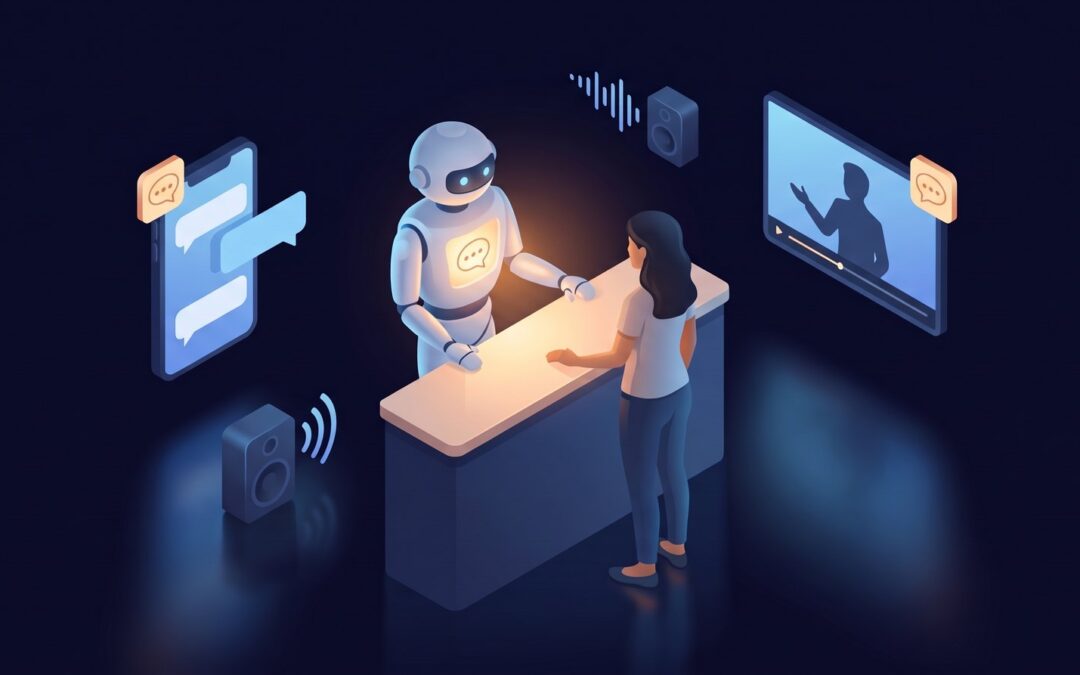
At Robust Data Solutions we're seeing more and more small businesses serve their customers with artificial intelligence: a chatbot on the website, an assistant that answers WhatsApp and books appointments, a voice that calls to confirm an order. Since August 2, 2026 there's been a simple new rule: anyone talking to an AI has to know it's an AI.
This comes from Article 50 of the EU AI Act, the transparency article. The postponement the EU approved in July, the Digital Omnibus on AI (in force since July 27), pushed back the high-risk obligations, but it didn't move this date.
Data checked as of October 5, 2026. General information, not legal advice.
What it requires, in four points
- An AI that talks with people says it's an AI, unless that's obvious. The European Commission's guidelines (July 20, 2026) give two examples: a chatbot that opens by saying it runs on AI, and a voice assistant that says so at the start of the call.
- Deepfakes must be labeled. An AI-made image, audio clip or video that imitates a real person and could pass for authentic has to say it's artificial. The Commission's example: a realistic avatar of the CEO congratulating the staff.
- Text on matters of public interest generated with AI must be labeled too, unless a person has reviewed it and someone takes editorial responsibility.
- The notice, clear and up front: at the latest at the time of the first interaction or exposure, and accessible to everyone.
One nuance: according to the guidelines, if your company developed the assistant and it runs under your company's name, the notice is your company's responsibility. If you use another vendor's assistant as is, ask the vendor to confirm how it complies.
Examples at a small business
- The website chatbot: a first message such as “I'm an artificial intelligence assistant” and, better still, a label that stays visible throughout the conversation.
- The WhatsApp assistant that replies and books appointments: the same, in the first message. And if it hands the conversation over to a person, make that clear.
- Calls with a synthetic voice: the voice says so at the start; a simple beep isn't enough.
- Videos with an avatar or a cloned voice: a visible notice. We do this ourselves: the videos we publish with our founder's cloned voice carry the notice “AI-generated voice based on Albert Lens, with his consent” and the TikTok and YouTube AI-content labels.
Deadlines and penalties
- Technical marking: makers of systems that generate content mark it in a machine-readable format. If the system was already on the market before August 2, they have until December 2, 2026 (European Commission and AESIA).
- Resources: a voluntary code of practice (June 10, 2026) and free EU icons for labeling AI content. The icons are optional; the notice isn't.
- Fines: up to 15 million euros or, for a company, 3% of its total worldwide annual turnover for the preceding financial year, whichever is higher; for SMEs, whichever is lower (Article 99(4) and (6)). In Spain, the draft organic law that sets the penalties has been before the Spanish Congress since June 12, 2026.
How we do it
For us, compliance starts at the design stage, not at the end. The assistants we deploy introduce themselves as AI, everyone signs in with their own permissions and everything is logged. Our AI never decides on its own: it proposes, and a person always makes the final decision. That’s what we call Human in the Loop.
Forrellat Consultors, our data protection partner and Data Protection Officer registered with the AEPD (Spain's data protection agency), reviews each project's data protection documentation before it's signed. More in Compliance and in Ungoverned AI.
If your company already uses AI with its customers, or is thinking about it, we'll go over it with you.
Frequently Asked Questions
Do I have to disclose that my website's chatbot uses artificial intelligence?
Yes, unless it's obvious. Since August 2, 2026, Article 50 of the EU AI Act has required that anyone talking to an AI know it from the first interaction. The simplest way: have the chatbot introduce itself as an AI assistant in its first message.
What counts as a deepfake under the AI Act?
An image, audio or video generated or manipulated with AI that resembles real people, places or events and could pass for authentic, such as a cloned voice. Whoever publishes it has to say it was made with AI.
What are the fines for not complying with Article 50?
Up to 15 million euros or 3% of total worldwide annual turnover for the preceding financial year, whichever is higher; for SMEs, whichever is lower. In Spain, the law that sets out the penalties is still going through Congress.